VPN and Foreign Casinos: The False Shortcut That Strips Every Protection

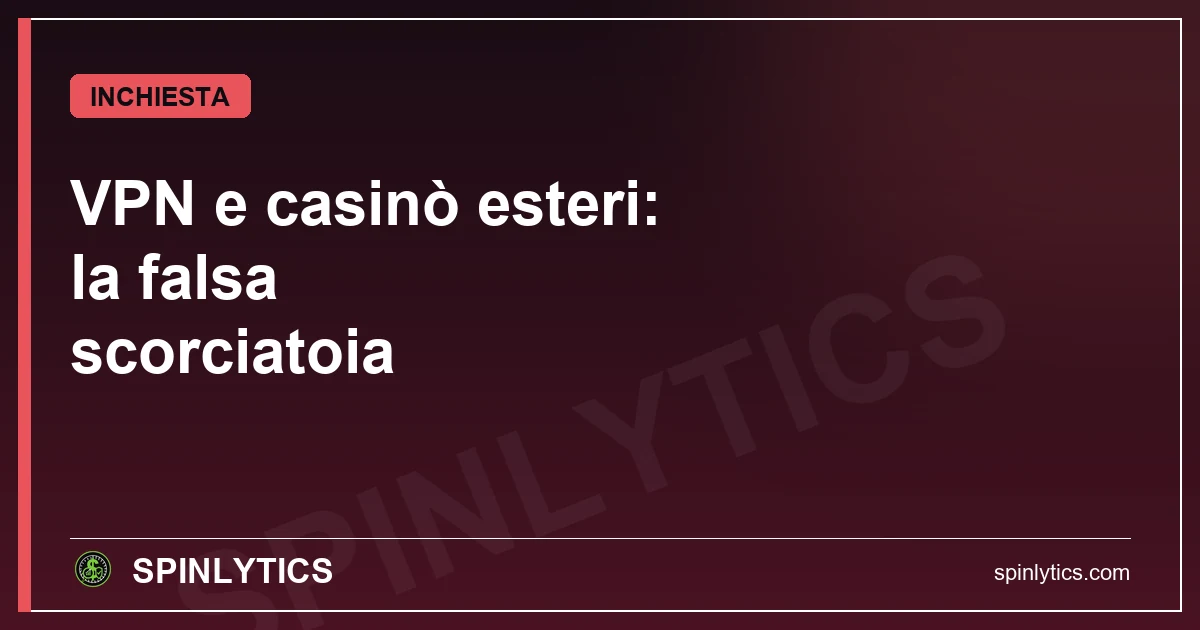
Using a VPN to play on a foreign casino is not a shortcut: it is giving up protections. The KYC paradox, the case of the bypassed self-exclusion, the privacy illusion and the real risks.
18+Legal NoticeGambling is only permitted for those aged 18 and over.Details
There is one word, in the underbrush of online gambling, peddled as the magic key to richer bonuses and limitless "freedom": VPN. The reasoning that comes with it is seductive in its simplicity — "I change location, I unlock foreign casinos, I play where I want". But it confuses two very different things: bypassing a technical block and bypassing a protection. The first is trivial; the second is a mistake that can cost dearly. This guide explains, without alarmism but without discounts, what it really means to use a VPN to play on a foreign casino — and why the "shortcut" is almost always the most dangerous road.
The point in two lines. Using a VPN to reach a foreign casino does not give you a shortcut: it removes a safety net. It does not bypass your gambling problems, it bypasses the protections that shield you — from the payout guarantee to the self-exclusion block. And often it is the very move that turns a "let me try" into a frozen account and lost money.
A note for international readers: in this article, terms like "foreign site" or "unlicensed casino" refer to operators running outside any real regulatory oversight — not to properly licensed international casinos. The reputable international operators reviewed on Spinlytics are vetted for reliability; the risk described here is the absence of protection, not a casino being based abroad.
Why the VPN Is Not the Shortcut It Seems
A VPN does one thing: it routes your traffic through a server in another country, making your connection appear to come from there. Born for privacy and corporate security, it is a wholly legitimate tool. The problem is not the VPN itself: it is the use made of it to reach a casino without an Italian licence.
Because in that case you are not "unlocking" anything good. You are taking a precise step: leaving the perimeter where the rules protect you to enter one where no one protects you. It is like climbing over a construction-site fence to take a shortcut — you may arrive sooner, but you just left behind every safety rule made for you.
What You Really "Unlock": The Absence of Protection
| What you think you get | What you actually get |
|---|---|
| Richer bonuses | Impossible requirements and hidden win caps |
| More freedom | No payout guarantee |
| Fewer checks | No referee if something goes wrong |
| Anonymity | The document must still be handed over at KYC |
| Bypassing the limits | Bypassing your own protection |
Informational, consumer-protection summary. Details in the non-AAMS casinos guide.
The KYC Paradox: The VPN Hides You, the Withdrawal Exposes You
Here is the bitterest irony of the whole thing. The VPN promises to hide you, but legal gambling — and many foreign operators too, when it is time to pay — requires identity verification. And it arrives at the worst moment: when you ask to withdraw a win.
At that point you must provide real documents, with a real name, address and nationality. If it emerges that you connected from another location via VPN, many foreign operators use exactly this inconsistency as a justification to freeze the account and withhold the money. There is no authority to appeal to, no complaint that counts. You hid to get in and exposed yourself to get out — empty-handed. The VPN, in this scheme, is not your weapon: it is often the perfect alibi not to pay you.
The Gravest Case: The VPN After Self-Exclusion
There is one use of the VPN that deserves separate treatment, because it touches the most fragile people. Someone who has self-excluded through the RUA performed an act of strength: with a signature, they closed every legal casino in Italy. In a moment of weakness, the VPN becomes the technical tool to climb over that barrier and reach the foreign sites the RUA does not touch.
This is where the "shortcut" shows its worst face. Because here it is not about trying a bonus: it is about dismantling, with your own hands, the only protection you gave yourself in a moment of clarity. The VPN does not offer an escape — it offers a relapse. If you recognise yourself in this, that moment is exactly when to call the helpline 800 558822: free, anonymous, without judgement.
And "Data Protection"? Another Illusion
Some justify the VPN by saying "at least it protects privacy". It is a technical misunderstanding. The VPN encrypts your network traffic, which makes sense on public Wi-Fi. But it does not protect the data you voluntarily hand over to the casino when registering: the ID document, address, payment details. Those, VPN or not, end up in the database of an operator outside EU jurisdiction, where your data rights mean little. The VPN protects the journey, not the destination. And the problem is entirely in the destination.
The Honest Conclusion
To sum up bluntly. The VPN is a legitimate tool used, in this context, for a purpose that backfires on whoever tries it. It does not make you freer: it makes you more exposed. It does not bypass gambling limits: it bypasses the protections those limits build around you. At best you pay a service to risk more; at worst, you use it to sabotage your own self-exclusion. The right question is not "how do I reach the foreign casino", but "why would I want to leave the only circuit where, when I win, the money is truly mine".

Bottom Line
Using a VPN to play on a foreign casino is not a clever shortcut: it is the conscious surrender of every protection. It does not guarantee payouts, does not hide the document you must still hand over at KYC, does not secure your data at the destination, and in the worst case becomes the tool to climb over a self-exclusion. The ADM circuit is not a cage to bypass: it is the reason that, when you win, you actually see the money. The VPN here does not open a door — it closes one behind you.
VPN and foreign casinos: FAQ
Is using a VPN to play on a foreign casino illegal?
The offence lies with the operator offering gambling in Italy without an ADM licence, not typically the player. But the point is not formal legality: with the VPN you are deliberately stepping out of the circuit that protects you, into one with no protection. The risk is not a fine: it is being left without a net.
Does the VPN really hide that I am playing from Italy?
It can mask location at the network level, but it is not invisibility. At KYC — mandatory to withdraw — you still provide real documents. If inconsistencies emerge between declared location, VPN and documents, many foreign operators use exactly this as a pretext to freeze the account and withhold winnings, with no referee at all.
Does the VPN bypass my RUA self-exclusion?
Technically foreign sites do not consult the RUA regardless of the VPN. But using a VPN to reach them means deliberately sabotaging the protection you gave yourself. If you self-excluded, that barrier is helping you: the VPN only tears it down. It is the heart of the foreign-casino scam.
If I win on a foreign site via VPN, will they pay me?
There is no guarantee. On the contrary: the VPN + Italian location combination is among the most-used reasons these operators void winnings, claiming a breach of their terms. You exposed yourself to maximum risk — deposit, data, document — with no certainty of payout.
Does the VPN at least protect my data?
A VPN encrypts network traffic, but does not protect the data you voluntarily hand over to the casino: document, address, payment details. Those still end up with an operator out of jurisdiction, where your protections mean little. The VPN on your device does not change where your documents end up.
Responsible Gambling
Online gambling should be a form of entertainment, not a source of income. If you feel gambling is becoming a problem, free support resources are available:
- ADM — Responsible Gambling
- GiocoHelpline freephone: 800 558822 (free, 24/7)
- Every ADM casino offers self-exclusion tools, deposit limits and reality-check reminders of time played.
Was this article helpful?
What could we improve?
Thanks for your feedback!