How a Live Casino Studio Works: Cameras, Sensors and Latency
Inside the studios broadcasting live tables: where they are, how sensors turn a result into data, and why video always arrives after the statistics.
Gambling is only permitted for those aged 18 and over. Please gamble responsibly. All casinos mentioned in this article are regulated and licensed by ADM (formerly AAMS), the Italian authority that oversees and authorises legal online gambling in Italy. → Verify the licence on adm.gov.it
A live casino table is, technically, a small television broadcast running twenty-four hours a day for years without a break. Cameras, direction, optical recognition of results and a video stream reaching tens of thousands of people at once. Here is how it works — and why the video sometimes looks "behind" the data.
The Studio: Warehouses Full of Tables
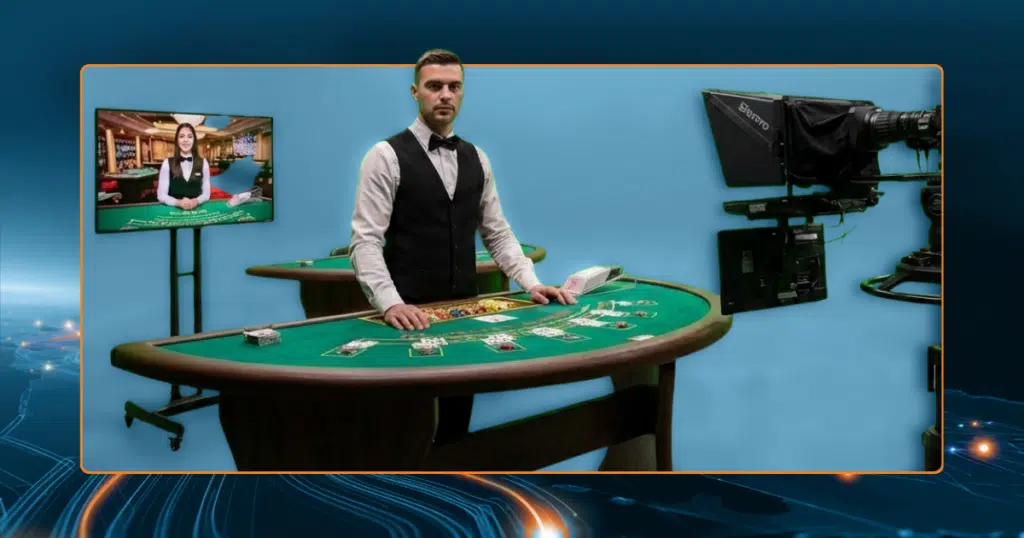
Studios are not casinos: they are industrial facilities built around filming, often enormous, with dozens or hundreds of soundproofed tables in rows. The sector's main sites sit in Latvia, Malta, Georgia, Romania and Estonia — countries chosen for labour cost, availability of multilingual staff and network infrastructure. Each table has its own set, lighting and dealer rotating on shifts.
How a Result Becomes Data
The most interesting part is the jump from the physical world to the digital one. Wheels and tables carry optical or magnetic sensors that automatically read where the ball stops, which segment landed, which cards were drawn. That is the same mechanism letting the system close bets, compute payouts and archive the round within moments, with no manual entry.
The statistics you see on Spinlytics come from that data too: we do not read the video, we read the already-digitised outcome the provider publishes round after round.
Why the Video Arrives After the Data
This is the technical question that comes up most. The video stream goes through encoding, segmentation into chunks, CDN distribution and finally buffering in your browser: that is seconds, sometimes many, of unavoidable latency. The outcome data, by contrast, is a handful of bytes travelling on its own with no encoding.
The result is that a stats page can show a round's outcome while the video still shows the ball spinning. It is neither an error nor a preview: it is the difference between transmitting a video stream and transmitting a number. For the same reason, no data you see early can be used to bet — bets close on the server before the spin, not when the video reaches you.

Why Some Tables Have No Public Stream
Table video is distributed to licensed operators, not freely. That is why on some games you find a cover image instead of a player: the result data stays public and trackable, the video feed does not. It is a provider distribution choice, not a technical limit of the tracker.
Redundancy: The Table Never Stops
A table going offline is immediate damage, so everything is doubled: power, connectivity, recording systems. Footage of every round is archived and can be retrieved to verify a disputed round long afterwards. It is the infrastructure that makes a dispute resolvable by watching a recording instead of arguing.
Watch the Data as It Runs
On the game pages you'll find results updated every round, bonus trackers and full history.
Responsible Gambling
Online gambling should be a form of entertainment, not a source of income. If you feel gambling is becoming a problem, free support resources are available:
- ADM — Responsible Gambling
- GiocoHelpline freephone: 800 558822 (free, 24/7)
- Every ADM casino offers self-exclusion tools, deposit limits and reality-check reminders of time played.