History of Roulette: From Pascal's Mistake to Live Streaming
How a failed perpetual motion machine became the casino's most famous table: the single zero, Monte Carlo 1913 and today's live variants.
Gambling is only permitted for those aged 18 and over. Please gamble responsibly. All casinos mentioned in this article are regulated and licensed by ADM (formerly AAMS), the Italian authority that oversees and authorises legal online gambling in Italy. → Verify the licence on adm.gov.it
Roulette was born from a failed physics experiment, crossed two centuries almost unchanged in shape, and is today the most imitated table in the live casino. The story of how it travelled from Parisian salons to HD streaming also explains why two versions with different RTPs exist.
One of Pascal's Mistakes
In the 1600s Blaise Pascal was trying to build a perpetual motion machine. The device did not work — of course — but the wheel it left behind was an excellent instrument for generating random outcomes. The game itself took shape later: roulette as we know it, with its number layout and betting table, appears in Paris towards the end of the 18th century.
The Single Zero and the Blanc Brothers
The decisive step comes in the mid-1800s. François and Louis Blanc introduce a wheel with a single zero, against the then-common one carrying two. Fewer zeros means less edge for the house: it was a commercial move before a mathematical one, a way to pull players away from rival tables.
That choice is still the reason for the gap between the two main variants:
| Variant | Pockets | House edge | RTP |
|---|---|---|---|
| European / French (single zero) | 37 | 2.70% | 97.30% |
| American (zero and double zero) | 38 | 5.26% | 94.74% |
Same game, same betting rules, nearly twice the cost to the player. That is the first reason to always check how many pockets a wheel has before sitting down.
Monte Carlo, the Myth and the Night of Twenty-Six Blacks
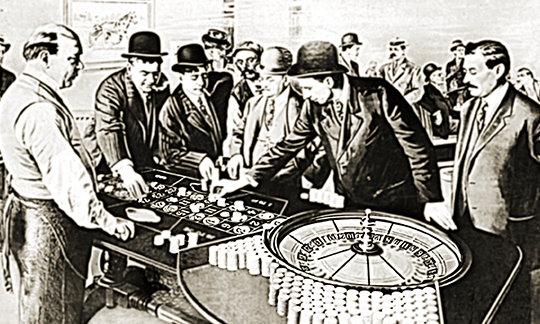
With the opening of the Monte Carlo casino, roulette becomes a cultural symbol. There, in 1913, the most cited streak in gambling history occurred: twenty-six consecutive blacks. That night also produced its lesson — the players doubling down on red and losing everything are the textbook example of the gambler's fallacy.

From the Physical Table to Streaming
Roulette was the first game broadcast live from the earliest live casino studios, for a simple reason: it is visually self-explanatory. Watching the ball settle tells you everything, no commentary required. From there began the rush of variants filling today's catalogues: roulette with random multipliers, dual-wheel roulette, roulette with board bonuses.
Modern Variants and What They Cost
Multiplier roulettes add spectacle but give nothing away: the extra prize pool is funded by reducing straight-up payouts, which drop below the classic 35:1. If you mainly bet outside (red/black, odd/even) the maths stays close to classic roulette; if you play straight-ups, the account changes. It is worth checking each variant's declared RTP before choosing it.
Live Statistics for Tracked Roulettes
Hot and cold numbers, column and dozen distribution, full spin history: Spinlytics tracks the main live roulettes in real time.
Responsible Gambling
Online gambling should be a form of entertainment, not a source of income. If you feel gambling is becoming a problem, free support resources are available:
- ADM — Responsible Gambling
- GiocoHelpline freephone: 800 558822 (free, 24/7)
- Every ADM casino offers self-exclusion tools, deposit limits and reality-check reminders of time played.