Bar Slots in the '90s: The Golden Age — Iconic Games and Italian Manufacturers
The 1990s golden age of Italian bar slots: Crazy Fruits, Jolly Joker, Lucky Lady's Charm. Italian manufacturers (HBM, Beltra, Amusement) and widespread diffusion before AAMS regulation.
Gambling is only permitted for those aged 18 and over. Please gamble responsibly. All casinos mentioned in this article are regulated and licensed by ADM (formerly AAMS), the Italian authority that oversees and authorises legal online gambling in Italy. → Verify the licence on adm.gov.it
The 1990s are the golden age of Italian bar slots: the decade in which the machines became fully digital, Italian manufacturers emerged as significant industrial players, the games became iconic and the phenomenon reached its maximum diffusion across the territory.
The Technological Transformation
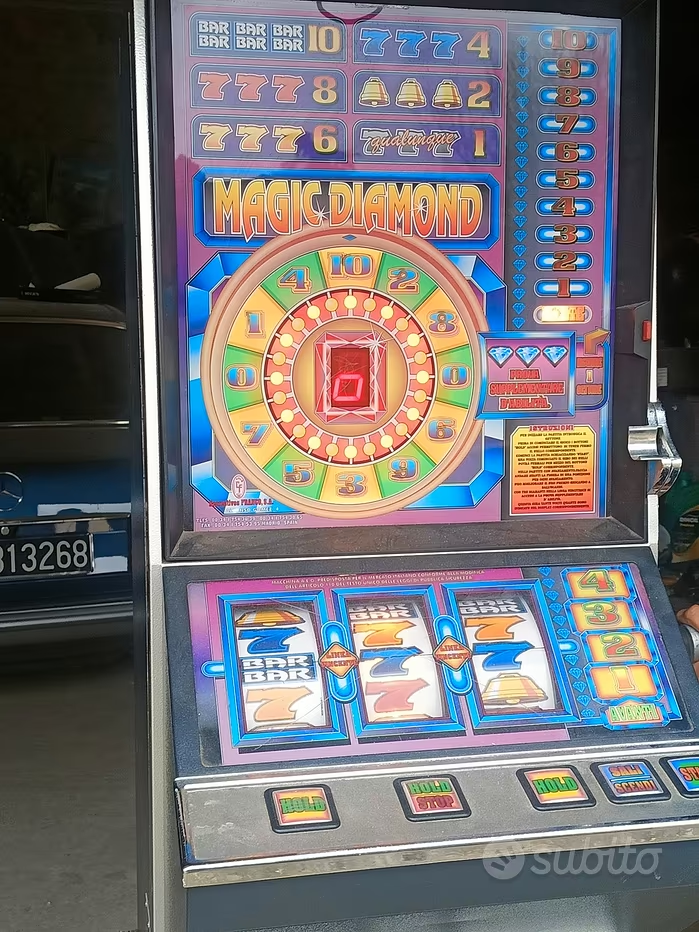
Compared to the 1980s, the technological leap of the 1990s was remarkable. The last mechanical components gradually disappeared: physical reels were progressively replaced by CRT and then LCD screens that simulated them graphically. The random number generator was now entirely software, on a dedicated microprocessor.
The interface evolved: multi-bet buttons (1, 2, 3 lines) appeared, along with bonus mini-games (secondary screens, "gamble/double up") and decorative LED lights in the cabinets. Sounds became richer with polyphonic audio chips — the characteristic bar-slot "jingle" was born, short and hypnotic melodies that would become the sound of an era.
The Iconic Games of the 1990s
Every operator had their favorites, but some models dominate the memories of Italian bar-goers of the 1990s:
| Game | Manufacturer | Distinctive feature |
|---|---|---|
| Crazy Fruits | Amusement / various | Animated fruit symbols, internal progressive jackpot, very widespread in Italy |
| Jolly Joker | Novomatic | Joker as wild, simple clean graphics, one of the best-selling in Europe |
| Magic Fruits 27 | Merkur / various | 27 paylines, three reels × three rows, heavily played in bars |
| Burning Wild | Novomatic | Wild that burns and expands, gamble/double-up feature on the flame symbol |
| Lucky Lady's Charm | Novomatic | Good-luck symbol, internal free spins, fixed jackpot — bar version (not online) |
| Sizzling Hot | Novomatic | High volatility for the era, hot fruits, jackpot on aligned symbols |
These models are bar machines (AWP/pre-AWP) — not the online slot versions that carry similar names. The technical characteristics and regulations are completely different.
Italian Manufacturers Emerge
The 1990s saw the growth of Italian manufacturers developing their own models, often based on adapted European hardware:
- HBM (Harting Bally Manufacturing): Italian-American joint venture, strong presence in central-northern Italy
- Beltra: Lombard manufacturer, robust and reliable hardware, many fruit models
- Amusement: present since the 1980s, scaled up production in the 1990s with its own models
- Sielcon: specialized in components and maintenance, then also direct production
Alongside these, the European brands remained very strong: Novomatic (Austria) dominated with Jolly Joker, Sizzling Hot, Lucky Lady's Charm. Merkur/Gauselmann (Germany) with the Magic Fruits series. Bally Wulff with various fruit models.
The Widespread Diffusion
In the 1990s bar slots definitively left the arcades alone to colonize every kind of venue: bars, tobacco shops, pizzerias, highway service stations, recreational clubs, bowling alleys. The presence of one or two machines became the norm even in the bars of small towns.
The economic model worked for everyone: the concessionaire earned without running the venue, the bartender supplemented revenue with passive income, customers had entertainment available 24 hours. There was no age control on users, no session limits, no play monitoring.
The "Gamble/Double Up"
One of the most characteristic features of 1990s bar slots is the gamble/double-up mini-game: after a win, the player can choose to "gamble" by trying to double it. Typically you choose between red and black (or high and low) on a face-down card — 50/50 odds. The player can gamble several times in a row.

This feature, so simple, contributed significantly to the machines' ability to keep the player engaged longer — a gambler's fallacy mechanism in physical form.
The Late 1990s: Crisis and Regulation on the Horizon
Toward the end of the decade, the pressure for regulation grew stronger:
- Rising reports of problem gambling
- Fiscal pressure: the State began to grasp the size of the sector and wanted to regulate the proceeds
- Inconsistency across the territory: some regions more permissive, others attempting restrictions
- Boom of the first online slots (1996-2000): new digital competition on the horizon
The response would come with Law 289/2002 and the AAMS/AWP system of 2004 — which would formalize everything, but also change the sector forever.
Frequently Asked Questions
What were the most famous bar slots of the 1990s?
How did the bar slot business work in the 1990s?
What technology did 1990s slots use?
Were 1990s bar slots legal?
How much did bar slots pay in the 1990s?
Responsible Gambling
Online gambling should be a form of entertainment, not a source of income. If you feel gambling is becoming a problem, free support resources are available:
- ADM — Responsible Gambling
- GiocoHelpline freephone: 800 558822 (free, 24/7)
- Every ADM casino offers self-exclusion tools, deposit limits and reality-check reminders of time played.